

Carers
Your rights and support as a carer.
Caring for someone you love is a big responsibility, and it is right that your own needs are recognised too. The support below is there to help you keep well, stay connected, and ease some of the financial pressure that caring can bring.
If the words and forms feel confusing, please do not worry — you do not have to manage this on your own. Benefit rates change from year to year, so always check the current amounts on gov.uk before you apply. Tap a topic below to read more.
Explore support for carers
Carer's Allowance (CA)
Applies to: England and Wales
https://www.gov.uk/carers-allowance (accessed August 2026)
Overview
You could get £86.45 a week if you care for someone at least 35 hours a week and they get certain benefits, such as DLA, PIP or AA.
You do not have to be related to, or live with, the person you care for.
You do not get paid extra if you care for more than one person.
If someone else also cares for the same person as you, only one of you can claim Carer's Allowance.
CA is not tax-free allowance, you have to pay tax on it if your income is over the personal income allowance.
You can choose to be paid weekly in advance or every 4 weeks. You can backdate your claim by up to 3 months.
Carer's Allowance can affect the other benefits that both you and the person you care for get.
You might be eligible for Carer's Credit if you're not eligible for Carer's Allowance.
Eligibility
The person you care for must already get one of these benefits:
- Personal Independence Payment - daily living component
- Disability Living Allowance - the middle or highest care rate
- Attendance Allowance
- Constant Attendance Allowance at or above the normal maximum rate with an Industrial Injuries Disablement Benefit
- Constant Attendance Allowance at the basic (full day) rate with a War Disablement Pension
- Armed Forces Independence Payment
You need to spend at least 35 hours a week caring for someone. This can include:
- helping with washing and cooking
- taking the person you care for to a doctor's appointment
- helping with household tasks, like managing bills and shopping
All of the following must apply:
- you're 16 or over
- you spend at least 35 hours a week caring for someone
- you've been in England, Scotland or Wales for at least 2 of the last 3 years (this does not apply if you're a refugee or have humanitarian protection status)
- you normally live in England or Wales, or you live abroad as a member of the armed forces (you might still be eligible if you're moving to or already living in an EEA country or Switzerland)
- you're not in full-time education
- you're not studying for 21 hours a week or more
- you're not subject to immigration control
- your earnings are £204 or less a week after tax, National Insurance and expenses
How to claim
To apply for CA online: https://www.gov.uk/carers-allowance/how-to-claim
Chinese-language guide: Carer's Allowance (CA) application guide in Chinese
Before you apply make sure you have your:
- National Insurance number (if you have a partner you'll need theirs too)
- bank or building society details (unless you get your State Pension)
- employment details and latest payslip if you're working
- P45 if you've recently finished work
- course details if you're studying
- details of any expenses, for example pension contributions or the cost of caring for your children or the disabled person while you're at work
You also need details of the person you care for. You need their:
- date of birth and address
- National Insurance number if they're 16 or over
- Disability Living Allowance reference if they're under 16
Change of circumstances
You must report changes in your circumstances if you're claiming or have applied for Carer's Allowance. Changes can include:
- starting a job
- starting or ending full-time education
- changes to your income
- you or the person you care for changing address
- stopping being a carer
- the person you care for no longer getting their disability benefit
- someone else who cares for the same person claiming Carer's Allowance instead of you
- someone else who cares for the same person claims the carer's element of Universal Credit
- changes to your immigration status, if you're not a British citizen
- you or the person you care for will be in hospital, a nursing home, or respite care for more than 12 weeks
- you stop caring for more than 28 days for any other reason.
- You must tell the Department for Work and Pensions if the person you're caring for dies.
You could be taken to court or have to pay a penalty if you give wrong information or do not report a change in your circumstances. You may have to repay the money if you have been paid too much.
Carer's Assessment
Overview
If you care for someone, you can have an assessment to see what help might make your life easier. This is called a carer's assessment.
It might recommend things like:
- someone to take over caring so you can take a break
- gym membership and exercise classes to relieve stress
- help with taxi fares if you don't drive
- help with gardening and housework
- training how to lift safely
- putting you in touch with local support groups so you have people to talk to
- advice about benefits for carers
A carer's assessment is free and anyone over 18 can ask for one.
How to get it
Contact adult social services at your local council and ask for a carer's assessment.
If you're a parent or carer of a child, contact the children with disabilities department.
Eligibility
You are a carer. If you are looking after someone regularly because they are ill, they are an older person or they are disabled – including family members.
Carers help with:
- washing, dressing or taking medicines
- getting out and about and travelling to doctors' appointments
- shopping, cleaning and laundry
- paying bills and organising finances
They can also give emotional support by:
- sitting with someone to keep them company
- watching over someone if they can't be left alone
During the carer's assessment
Someone from the council, or an organisation the council works with, will ask how you're coping with caring.
This includes how it affects your physical and mental health, work, free time and relationships.
The assessment is usually face to face. Some councils can do it over the phone or online.
Assessments usually last at least an hour.
You'll need:
- your NHS number (if you have one)
- your GP's name, address and phone number
- contact details of anyone who's coming to the assessment with you
- the name, address, date of birth and NHS number of the person you care for (if you have it)
- your email address
Give as much detail as you can about the impact caring for someone is having on your life. This will help make sure you get all the help and support you need.
You can have someone with you during the assessment. This could be the person you care for, a friend or relative.
You could also use an advocate. Advocates are people who speak up on your behalf. They can help you fill in forms and sit with you in meetings and assessments.
Results
The local council will tell you the results of the assessment.
If you qualify for help from the council, they'll write a care and support plan with you that sets out how they can help.
Carer's Card
Carer's Card UK
https://www.carerscarduk.co.uk/ourcard (accessed August 2026)
Overview
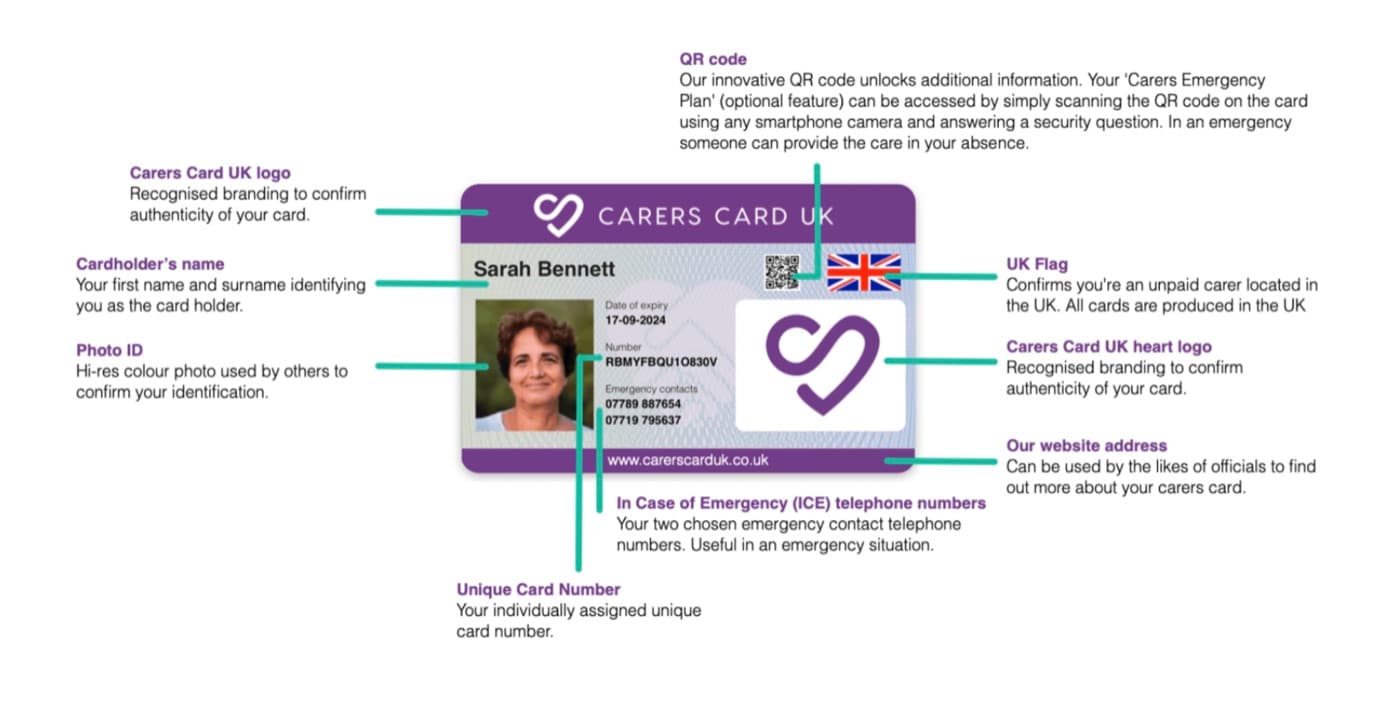
Your Carers ID Card is a physical card that proves you are a carer.
Showing your card can unlock a range of benefits, resources, and understanding when you need support. It is a practical tool that helps you wherever you go.
The card includes the following information (see photo below):
- Cares Card UK logo
- Your name and photo
- Unique card number
- Emergency contacts
- QR code and UK flag
- Cares Card UK website address
How to get it
Click here to register for Carers Card UK: https://www.carerscarduk.co.uk/eligibility-type-of-carer
It costs £8 for 2 years, no hidden fees. Renew after two years for the same price.
Carer's Credit
https://www.gov.uk/carers-credit (accessed August 2026)
Overview
You could get Carer's Credit if you're caring for someone for at least 20 hours a week.
Your income, savings or investments will not affect eligibility for Carer's Credit.
Carer's Credit is a National Insurance credit that helps with gaps in your National Insurance record. Your State Pension is based on your National Insurance record.
If you're eligible for Carer's Credit, you can get credits to help fill gaps in your National Insurance record. This means you can take on caring responsibilities without affecting your ability to qualify for the State Pension.
You can still get Carer's Credit even if you have breaks from caring (up to 12 weeks in a row).
Eligibility
To get Carer's Credit you must be:
- aged 16 or over
- under State Pension age
- looking after one or more people for at least 20 hours a week
The person you're looking after must get one of the following:
- Disability Living Allowance care component at the middle or highest care rate
- Attendance Allowance
- Constant Attendance Allowance
- Personal Independence Payment daily living part
- Armed Forces Independence Payment
If the person you're caring for does not get any qualifying benefits, you may still be able to get Carer's Credit.
When you apply, fill in the 'Care Certificate' part of the application form and get a health or social care professional to sign it.
You do not need to apply for Carer's Credit if you:
- get Carer's Allowance - you'll automatically get credits
- get Child Benefit for a child under the age of 12 - you'll automatically get credits
- are a foster carer - you can apply for National Insurance credits instead
How to claim
Download the claim form: https://www.gov.uk/government/publications/carers-credit-application-form
You can also get the form by calling the Carer's Allowance Unit on 0800 731 0297.
Send the completed form and Care Certificate to Freepost DWP Carers Allowance Unit (free of charge; the recipient pays the postage).
More in Benefits & Entitlements
Need support for your family?
Reach out and we will help you find the right guidance for you or the people you care for.